

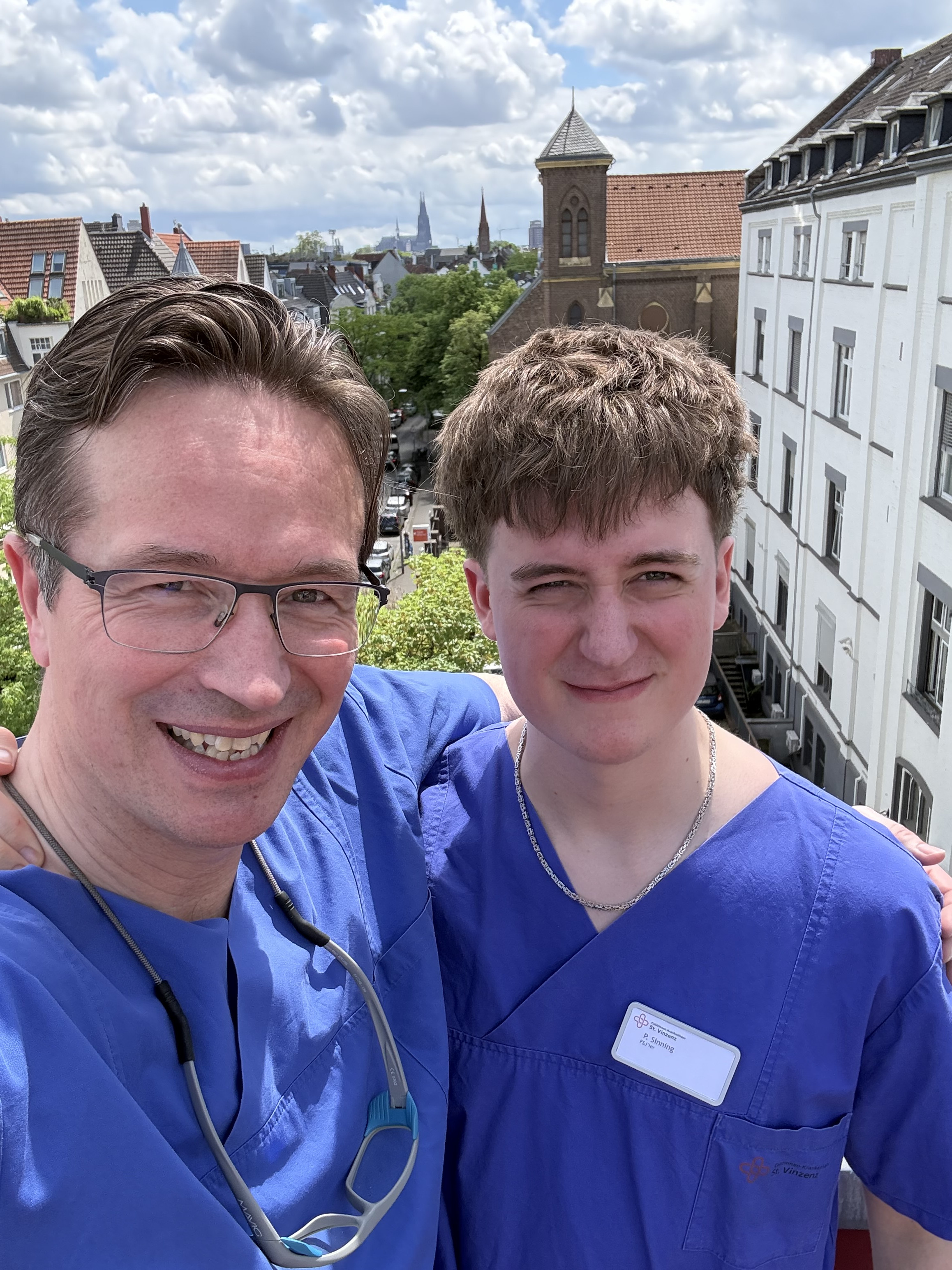
Jan-Malte Sinning wanted to be a surgeon. A grant took him into the German army, an unexpected posting led him to the cath lab, and Afghanistan made him rethink his future. In his own words, this is the story of finding the work he loved and what it took to pursue it.
Words by Jan-Malte Sinning
For someone who has spent years treating complex coronary disease and teaching other operators, Jan-Malte’s first ambition may come as a surprise, he wanted to be a surgeon.
"I always wanted to become a surgeon. I even did my MD thesis in surgery."
His route into medicine began with a practical decision, and one he now recalls.
"When I left school, I thought it might be a good thing to have some kind of grant for medical school. As a pupil, I always worked a lot, earned a lot of money, but I also liked to spend a lot of money."
The German armed forces offered him a way to fund his studies, and he successfully applied for a grant. After six years studying medicine at the University of Cologne, he began his medical career at the military hospital in Koblenz in 2003. By then, military deployments were already shaping his thinking.
Love at first glance
"I remember very well that first day I arrived at the hospital. They told me, 'No one wants to go to cardiology. You're the fifth resident arriving today, so you'll be the one who has to go.'"
It was hardly the introduction he had expected, but Jan-Malte was willing to give it a chance. "I said, 'Well, yes, let's have a try.” Within his first hour in cardiology, he was sent to the cath lab to help prepare equipment and perform manual compression following catheterisation.
"It was something I will never forget, because it was like love at first glance. I saw what was going on in the cath lab and said, 'Wow, that's what I want to do.'"
From that moment, Jan-Malte knew what he wanted.
"My former boss wanted to force me into gastroenterology. I remember several days when I worked there, did ultrasonography, gastroscopy and colonoscopy, and then left and went to the cath lab." "He followed me into the cath lab to complain, 'What are you doing in the cath lab? Let's get back to gastroenterology,' he'd say.
Jan-Malte's enthusiasm for cardiology was clear, but being part of the military meant that pursuing it wasn't entirely within his control.
A decision bigger than medicine

In 2006, Jan-Malte deployed to Kosovo as an emergency physician on a NATO mission.
Two years later, he was sent to Afghanistan. By then, his first child, was five months old.
"That was a hard time. My wife was trying to film as much as she could. Back in those days, we didn't have any iPhones, so when we were going for a walk with our son, she was behind me with a video camera; if I didn't return from Afghanistan at least, she’d have footage to be able to show our son what his father had looked like."
Jan-Malte was again working as an emergency physician, accompanying military units into the field.
"I often went out into the field with soldiers from Sweden, Norway and other nations, while they carried out their missions. I would wait nearby in my emergency vehicle, ready to provide medical assistance to wounded soldiers. In reality, however, most of the patients I treated were civilians. Although this had little to do with cardiology, it gave me a sense that I was at least doing something meaningful during these military missions."
But the experience made him even more certain about the direction he wanted his career to take.
"I knew that I didn't want to do what I did there. Don't get me wrong, but I'm not a soldier, I'm not a fighter. I just wanted to be a cardiologist. That strengthened my wish and will to become a cardiologist."
When he got home, he decided to leave the military and pursue a career in medicine outside the armed forces. It wasn't straightforward.
"I had to pay back the grant money. That was a hard decision that I made with my wife, but she was also convinced that this was the best way because we really had a hard time."
It meant giving up the security of the career he had originally chosen to fund his medical education, but it was a decision that would change the course of his life.
Starting again
In 2008, Jan-Malte began his career (again) at the University Hospital of Bonn. Despite already having five years of medical experience, he found himself starting over.
"After five years, I had to start from the beginning. That was a tough time because actually I would have been a senior resident, but I had to start as a junior resident."
He started in intensive care, a department that wasn't particularly popular at the time. But once again, he found an opportunity where others hadn't.
"I was taken back into the cath lab for more than a year. There, I started to do PCI in 2009 and 2010, and I also started to do TAVI, which was really a big thing back in those days."
Alongside his clinical work, research became an increasingly important part of his life. But combining the two with family life came at a cost.
"I worked during the day as a physician, and when I returned home, I put the kids to bed. Once they fell asleep, I went back to my desktop and did studies until one or two AM. Then I'd go to bed and would be back at the hospital early next morning."
He became a consultant in 2014, focusing on interventional cardiology, complex PCI and intravascular imaging, while also developing his research in TAVI. Looking back, he is proud of what he achieved, but he is also honest about what those years demanded.
"I don't regret what I did, but I wish I could have spent a lot more time with the family, especially with my kids."
The people who made it possible

When Jan-Malte talks about the people who supported him along the way, one person stands out above everyone else.
"Without my wife, I wouldn't have been able to do everything that way. That's something that is really for sure."
"My son is now 19 and will go to medical school next month in Düsseldorf. While we've been in Cologne together, it’s been important to us that we were going to every soccer match of our local team." He always said, 'I’ll meet my friends later. We go together to the soccer match, and after that I'm doing my stuff.'"
"These quality moments have always been very important for me and also for the kids. I don't regret anything, and without having done what I did I wouldn’t be sitting here."
There is another reason he looks back on those years with pride. His son, who once had no intention of following his father's career, is now considering medicine himself.
"If you had asked him years ago, he would have said, 'No, I don't want to become a doctor. I don't want to do the same as you.' But he did a voluntary year at the hospital and after that he was really infected by this thing. Now he wants to become a doctor, and maybe also a cardiologist."
Professionally, Jan-Malte is equally grateful for the people who helped shape his development. He speaks particularly warmly about two mentors who became close friends.
"One of them, I met this afternoon. He's 82 years old. He always helped me by sharing his ideas, experiences and stories. The other is also now a close friend."
The second mentor had looked after him when he first arrived in Bonn as a junior resident, and they went on to work together on research and interventional cardiology.
"He took care of me when I arrived in Bonn as a junior resident. He was already a junior consultant in those days, and he liked me and what I did. I did a lot of research together with him."
His influence was particularly important when Jan-Malte began considering what the next stage of his career might look like.
A new beginning in Cologne
By this point, Jan-Malte had developed into a senior consultant, leading the cath lab and TAVI programme in Bonn. He had achieved a great deal but began to question whether he wanted to remain in the same environment.
"I thought, well, I learned everything I could, and I achieved everything I could, and I have to decide whether I want to stay in this position."
He began looking for a new opportunity and applied for a leadership position at St. Vincent's Hospital in Cologne in 2019.
"I was lucky that I was selected. I did a lot of work on that, but I was a lot under pressure. I remember that very well."
The move brought another significant challenge. His family had to relocate, find a new house and arrange schools for the children, all during the COVID-19 pandemic.
"We had to move, find a new house during the COVID pandemic. At the beginning of 2020, we were looking for a new school for the kids, to buy a new house and all these things that are really difficult under these circumstances."
He started his new position in May 2020, but getting to know his colleagues was an unusual experience. "I knew the consultants in my team, but the other team members I only got to see more than their eyes a year later when a next summer festival we all met without COVID masks."
Since arriving, he has focused on developing the complex PCI programme, introducing new imaging techniques and expanding the range of procedures available to patients.
"We started with universal imaging. We have IVUS, OCT, rotational atherectomy, all these calcium modification tools, Impella-protected PCI. We're doing now a lot of retrograde CTO procedures as well."
He is particularly proud of the experienced team around him.
"All my team members are quite experienced and they're doing a great job, and the team is lovely. That's the main reason why I love to go to work."
Although heading a department brings its own challenges, with staff issues, supply issues and the many other demands competing for his attention, one part of the job remains his favourite.
"The part I most enjoy still is being in the cath lab and treating my patients." "I love to do these complex procedures, to plan something. For example, also super complex CTO, to have a plan, then do what you can do. I like to do manual things.
And if a plan works at the end of the day, that's complete satisfaction." Asked about his decision to pursue PCI Jan-Malte says, "That first day in the cath lab was something I’ll never forget.
I saw what was going on and told myself, 'Wow, this is what I want to do.'"