

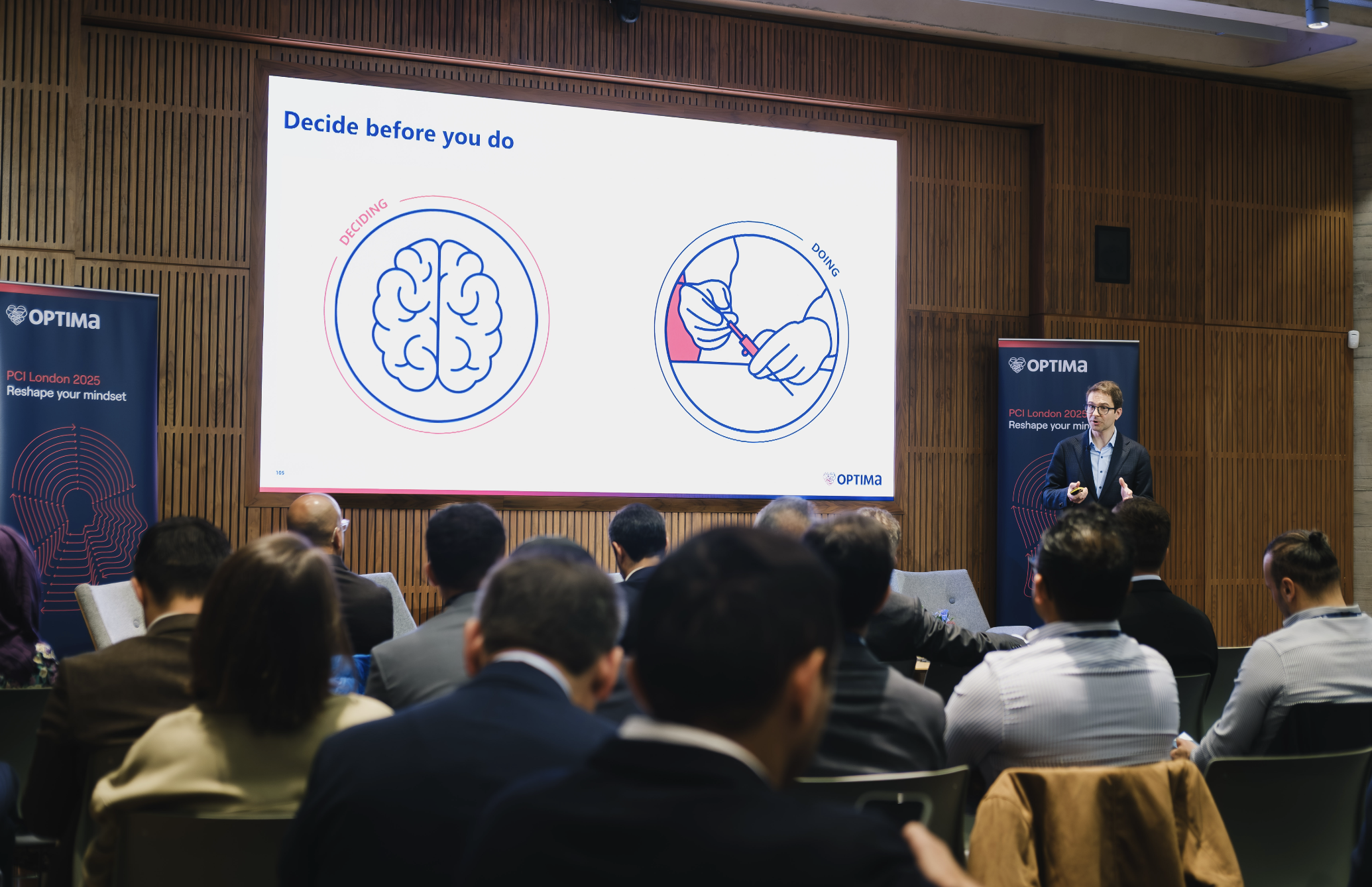
Q1. Why is decision-making so important in complex PCI now?
Matthew Sibbald:
We are in a risky profession. We take risks on behalf of our patients, and we want to do well by them. We also recognise that we can achieve amazing outcomes, and can do so in a pretty seamless way, with such a wide variety of technology at our fingertips. The biggest challenge is choosing the right stuff at the right time. If you do not, the impact could be really dire for a patient. That is why proactive PCI is so important. It gives us a moment to plan, reflect and get all of our ducks in order so that we have the best result possible for our patients, which is something that we all want.
Q2. What does a proactive mindset look like?
Matthew Sibbald:
Calm and cadenced, so that you can approach the risks knowingly and thoughtfully. You have a backup, and maybe more than that: you have a backup to the backup, so that you have everything covered. I think that is the type of physician I would want to go to for my procedure.
Q3. Is there an example outside the cath lab where you embody that mindset?
Matthew Sibbald:
I did a fair bit of piano training as I grew up, and I left it for a long time. I then came back to it, in my gradual ageing, as a hobby that I use to relax and enjoy. I came back with the idea that I would never have the same technical proficiency as when I was young. I am older, my hands do not move in the same way, and I do not spend the colossal number of hours that I might formerly have done.
I think that idea was wrong, to be honest. It is not as much of a technical thing as one might see. Sure, there is some strength element to it, but some part of it is doing things excruciatingly slowly and thinking of appropriate strategies to tackle something that is difficult. It is that slow, incremental progress that you do not see one little iteration at a time, but at the end of a month or six months you have made unbelievable progress that you never thought was possible.
I think that is a microcosm of some of the hard work we do in the lab. It is not as much about technical finesse as we think. Sometimes it is just about using your head and not doing things that are careless and risky.
Q4. How do wellbeing and life outside the lab support clinical performance?
Matthew Sibbald:
They are really a set of pillars that come together. We often neglect our personal lives. It is easy to get caught up in the throes of procedural work; there is always another procedure to do.
Many of us spend lots of time in the lab, but I do not think we realise how much what happens outside the lab influences what we do in the lab. It is not just about getting enough sleep, though that is very, very important. It is also about treating our bodies well and treating our minds well.
Some part of that is finding our own inner peace in whatever we do: how we rest and recharge, whether it is family, running or a musical hobby. I have two young kids, and it is great to chase them around.
There has to be some balance in all of it, and we take that balance with us to the lab. That is part and parcel of the outcomes we achieve for patients, and it is also the way we relate to patients.
We are not only a clinician, but a person, and in that person is the wisdom and decision-making that we need to treat and serve our patients best.
Q5. What role does wellbeing play in decision-making?
Matthew Sibbald:
Cath labs are complicated environments. We bring our full selves into that lab. The lab may be running late; there may be a nurse who is disoriented and struggling to keep up with the procedure; and you may be irritated and frustrated, and short with the team.
That same whole set of emotions is also what you bring to the decision-making. It is not only that you are being short with the team and rushing through; you are doing the same with the decision-making and with the treatments you apply for a patient.
How much better to have done your morning yoga or run and to show up feeling refreshed. Sometimes the nurse is still disoriented and sometimes the lab is still running late, but the way you are able to tackle those environmental stresses and tensions, and then tackle the decisions you are making on behalf of a patient, is totally different.
We see that play out in the outcomes, and when we reflect at the end of the day and ask whether it was a good day in the lab. For most of us, it is not the number of patients we have served, but actually feeling that we did a really good job.
One of the great pleasures of this work is that there is immediate gratification, especially when a patient comes in having a heart attack and struggling, and leaves the lab comfortable. That is really rewarding, and I think that is why many of us do what we do.
Q6. How do radiation safety, anxiety and cognitive load interact?
Matthew Sibbald:
It works both ways. Many of us, as we enter interventional cardiology, perseverate around the radiation impact. It is ethereal, but it affects all of us.
We buy equipment, spend lots of time making sure we are gowned and geared up, and are very meticulous and careful about angles and how we set up the room. Sometimes we put on lead that is twice as heavy because we think it will give us an extra layer of protection.
There is a cost. Sometimes we are so focused on whether we are keeping everybody safe that we are not actually focused on whether we are doing the best job for a patient.
The counterpoint is that we can also get so engrossed in trying to get a wire down, get equipment to go, or bring a case to a close after two or three hours, that our radiation protection goes completely out the window.
We neglect the amount of radiation we are using, stop optimising our angles, do not shift our gear, and forget after the alarm has gone off multiple times because our cognitive load has become overpowering.
The system is not set up simply to be safe. We have to actively participate in that safety, and we can lose track of it. Radiation safety is therefore about keeping enough space to do the procedure properly, but also not losing sight of the safety itself when we become engrossed.
Q7. What practical advice would you give operators about radiation safety?
Matthew Sibbald:
Pick the strategy that is going to work best first. That means having a plan.
The idea that we might just get away without rotablating, perhaps use a suboptimal access point, or not use the big guide almost never works. You end up doubling the procedural time.
Even worse is going in without a strategy and saying, ‘We will just see how the lesion behaves.’ I think that is a recipe for things to be much longer and much less safe than picking the best strategy up front.
I thoroughly endorse doing the work beforehand and choosing the best strategy first.
As Course Director of The Optima PCI Course Matt will bring this same calm, considered approach to London. Join him and a faculty of leading PCI specialists for practical, case-based learning focused on better decision-making in complex PCI.